
In many uncontested divorces in Leawood, especially those involving no children or disputes, you may not need to appear in court. However, if disagreements exist or if judicial review is required, a court hearing will be scheduled in your county’s district or circuit court depending on whether you’re filing in Kansas or Missouri. Even in cases that settle quickly, some courts require final approval from a judge to finalize the divorce. Your attorney will help prepare all required documents and advise you on whether a court appearance is necessary.
At the Law Office of Daniel E. Stuart, P.A., we know how overwhelming the divorce process can be, especially when spousal support is involved. These situations often come with financial stress, emotional uncertainty, and difficult decisions about long-term obligations. As experienced attorneys who have served individuals since 1994, we understand the pressure you’re under. Our goal is to give clients the legal support they need to move forward with stability and confidence.
Key Factors That Influence Spousal Support Decisions
Spousal support, commonly referred to as alimony, is a court-ordered payment from one spouse to another following a separation or divorce. This arrangement is intended to help the receiving spouse maintain a reasonable standard of living when there is a financial imbalance between the two parties. The court typically looks at factors like the length of the marriage, each spouse’s income and future earning potential, age, health, and the contributions each person made during the marriage.
Alimony in Leawood can take several forms—temporary, short-term, or long-term—and may be modified in the future based on changes in circumstances such as remarriage or significant shifts in income. These variables often leave people uncertain about what to expect or what they may owe or receive.
Clients who come to us usually aren’t looking for conflict—they want fair results, clarity, and peace of mind. They’re often worried about financial strain or being treated unfairly during negotiations. As experienced attorneys, we focus on the outcome that truly matters: a support arrangement that reflects the situation honestly and allows both parties to move forward.
We help clients by:
- Identifying whether support is appropriate and calculating potential payment amounts
- Reviewing or negotiating existing alimony terms to match current financial conditions
When you need our
residents trust to give you sound, practical advice, we’re here to help you understand your options clearly and confidently.
Proven Experience That Makes a Real Difference
Choosing the right legal team matters when your financial future is at stake. At the Law Office of Daniel E. Stuart, P.A., we bring over 30 years of legal experience to every case, including sensitive family law matters like alimony and divorce. Attorney Daniel Stuart is licensed in Kansas, Missouri, and New York, and has built a reputation for honest counsel and strong legal advocacy.
Our experience means we know what local courts consider fair and how to prepare effective cases for our clients. We’ve represented individuals from all backgrounds, guiding them through difficult situations with straightforward advice and solid results.
What sets us apart:
- Decades of legal practice in multiple states
- A commitment to clear, personal communication with each client
- A history of strong case outcomes and client satisfaction
What To Do Immediately After A Divorce
 Divorce often involves legal, financial, and personal changes that call for timely action. Taking clear steps early can help avoid missed deadlines, prevent future disputes, and provide a sense of stability during a transitional period. A law firm that focuses on family law matters and maintains direct attorney involvement throughout each case understands how post-divorce decisions can affect long-term outcomes, from property matters to parenting arrangements. The firm’s practice also emphasizes clear communication and practical guidance, which can be especially helpful when questions continue after final orders are entered. Taking action soon after a divorce is finalized can make the next stage more manageable, particularly for those working with our Leawood, KS divorce lawyer.
Review the Final Divorce Decree Carefully
The first step after a divorce is to read the final decree in full. This document outlines property division, support obligations, and custody or parenting plans. Understanding the specific terms helps avoid accidental violations and allows timely follow-up if clarification is needed.
Update Financial Accounts and Records
Bank accounts, credit cards, and investment accounts may need to be closed, divided, or renamed. Beneficiary designations on retirement plans and insurance policies should also be reviewed. These updates help reflect current circumstances and reduce future disputes.
Address Parenting and Custody Logistics
For parents, daily schedules often change after divorce. Using a shared calendar, confirming exchange locations, and establishing clear communication methods can help avoid confusion. This is often one of the most immediate adjustments addressed with guidance from our Leawood divorce lawyer.
Change Estate Planning Documents
Wills, trusts, and powers of attorney frequently name a former spouse. Updating these documents aligns estate plans with current wishes and avoids unintended outcomes. This step is often overlooked but remains an important part of post-divorce planning.
Secure Important Personal Records
Copies of birth certificates, Social Security cards, passports, and financial records should be kept in a secure location. Having organized records makes future transactions and legal matters easier to manage.
Update Insurance Policies
Health, auto, and homeowner’s insurance policies may need revisions. Coverage levels, named insured parties, and contact information should be reviewed. These changes help prevent coverage gaps or billing issues.
Establish a New Budget
Income and expenses often shift after divorce. Creating a realistic budget helps account for support payments, housing costs, and daily expenses. Clear budgeting supports financial stability during the adjustment period.
Follow Court-Ordered Deadlines
Support payments, property transfers, and refinancing obligations usually come with deadlines. Tracking and meeting these requirements reduces the risk of enforcement actions or additional legal issues.
Monitor Credit and Financial Standing
Checking credit reports after divorce can reveal joint accounts or debts that still need attention. Addressing these early helps protect long-term financial health.
Plan for Ongoing Legal Questions
Even after a divorce is final, questions may arise about enforcement, modifications, or compliance. Staying informed about available legal options allows timely responses if circumstances change.
Moving Forward After The Final Orders Are Entered
Our Leawood divorce lawyer can provide guidance on post-divorce concerns and help address issues that arise after court orders are in place. Taking these steps shortly after divorce can help reduce stress and prevent future disputes. Those who have questions about compliance, modifications, or next steps are encouraged to seek legal guidance to review their situation and discuss available options. For continued support and practical legal assistance following divorce, individuals may contact the Law Office of Daniel E. Stuart, P.A.
Leawood Divorce Infographic

At the Law Office of Daniel E. Stuart, P.A., we understand that dealing with spousal support during a divorce can be challenging. Since 1994, we’ve been assisting clients in Leawood and beyond, providing clear guidance and dedicated representation. Our aim is to help you achieve a fair outcome that reflects your unique circumstances.
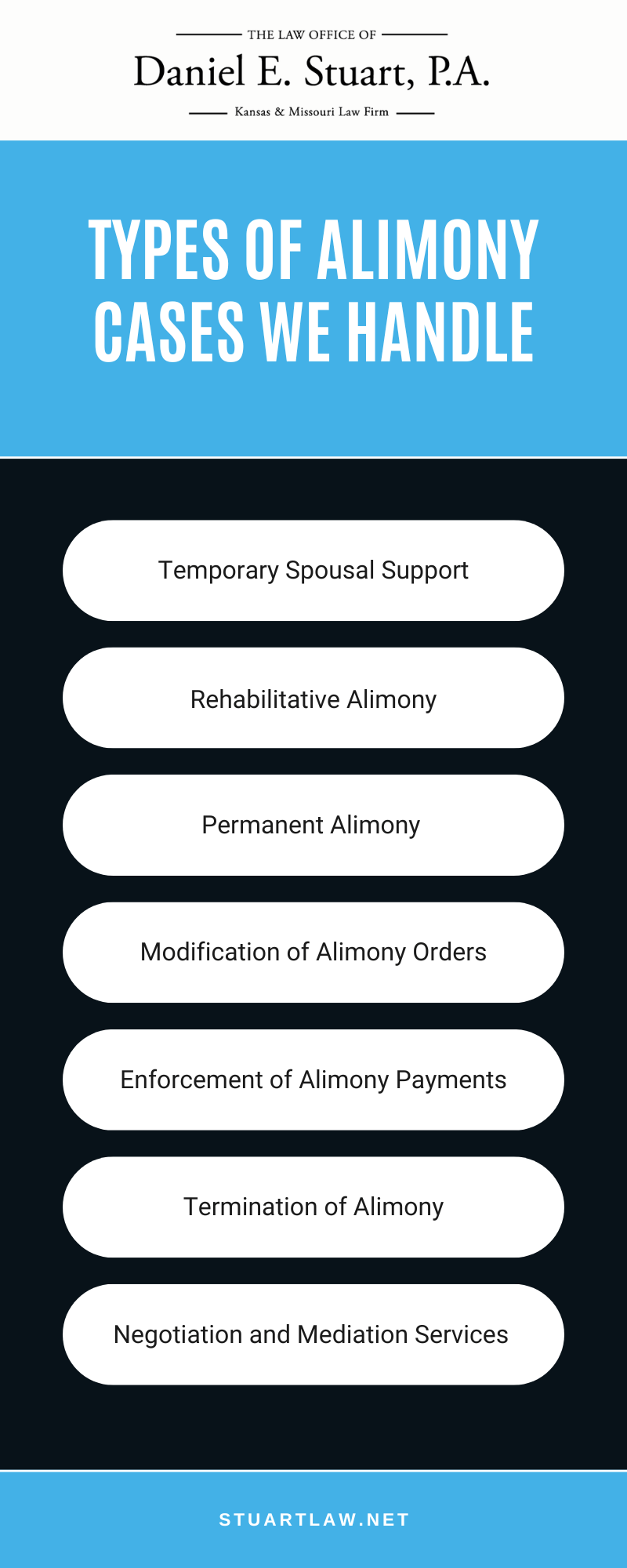
Types of Alimony Cases We Handle
- Temporary Spousal Support. We assist clients in obtaining temporary financial support during the divorce process to maintain stability until a final agreement is reached.
- Rehabilitative Alimony. Our team helps establish support arrangements that provide financial assistance while the receiving spouse gains education or training to become self-sufficient.
- Permanent Alimony. In cases where long-term support is appropriate, we work to secure arrangements that consider the duration of the marriage and the financial needs of the dependent spouse.
- Modification of Alimony Orders. We represent clients seeking to modify existing alimony agreements due to significant changes in circumstances, such as income or employment status.
- Enforcement of Alimony Payments. Our firm takes legal action to enforce court-ordered alimony payments when the paying spouse fails to comply with the established terms.
- Termination of Alimony. We advise clients on terminating alimony obligations when appropriate, such as in cases of remarriage or cohabitation of the receiving spouse.
- Negotiation and Mediation Services. We provide negotiation and mediation services to help spouses reach mutually agreeable alimony arrangements without litigation.
Why Experience Matters in Alimony Law
Experience is crucial when dealing with alimony matters, as it ensures informed decision-making and effective representation. At the Law Office of Daniel E. Stuart, P.A., our extensive background in family law provides clients with the confidence that their cases are handled with professionalism and knowledge.
- Over 30 Years of Legal Experience. Attorney Daniel E. Stuart has been practicing law since 1994, bringing decades of experience to each case.
- Licensed in Multiple States. Mr. Stuart is licensed to practice law in Kansas, Missouri, and New York, offering a broad perspective on family law matters.
- Recognized for Excellence. The firm has received the AV Preeminent Rating from Martindale-Hubbell, reflecting the highest level of professional excellence.
- Dedicated Family Law Practice. Our focused practice in family law ensures that we stay current with legal developments and best practices in alimony cases.
- Proven Track Record. We have successfully represented numerous clients in alimony matters, achieving favorable outcomes through negotiation and litigation.
If you’re facing alimony issues in Kansas City, don’t hesitate to reach out. Contact the Law Office of Daniel E. Stuart, P.A. today to schedule a consultation and take the first step toward resolving your spousal support concerns.
Leawood Divorce Infographic
Leawood Divorce Statistics
Divorce is a prevalent social issue affecting millions of people worldwide. In the United States, divorce rates have been a topic of interest for decades, with various factors influencing the likelihood of marriage dissolution. According to data from the Centers for Disease Control and Prevention (CDC) and the American Psychological Association (APA), divorce rates are influenced by demographic, socioeconomic, and cultural factors.
Key Statistics
- Prevalence Of Divorce: Approximately 40-50% of marriages in the U.S. end in divorce. While this figure has remained relatively steady over the years, it varies based on factors such as age, education level, and socioeconomic status. Younger couples and those with lower levels of education tend to have higher divorce rates.
- Age And Divorce: The likelihood of divorce decreases with age. Individuals who marry after the age of 25 are statistically less likely to divorce than those who marry at a younger age. For example, people who marry in their teens have a much higher divorce rate, sometimes exceeding 60%.
- Children And Divorce: Divorce rates are higher among couples with children. Children of divorced parents are more likely to experience divorce themselves. However, couples with children often stay married longer than childless couples due to financial and social pressures.
- Factors Influencing Divorce: Common reasons for divorce include financial stress, lack of communication, infidelity, and domestic violence. Financial issues are often cited as the primary reason for divorce, especially in marriages with high debt or financial instability.
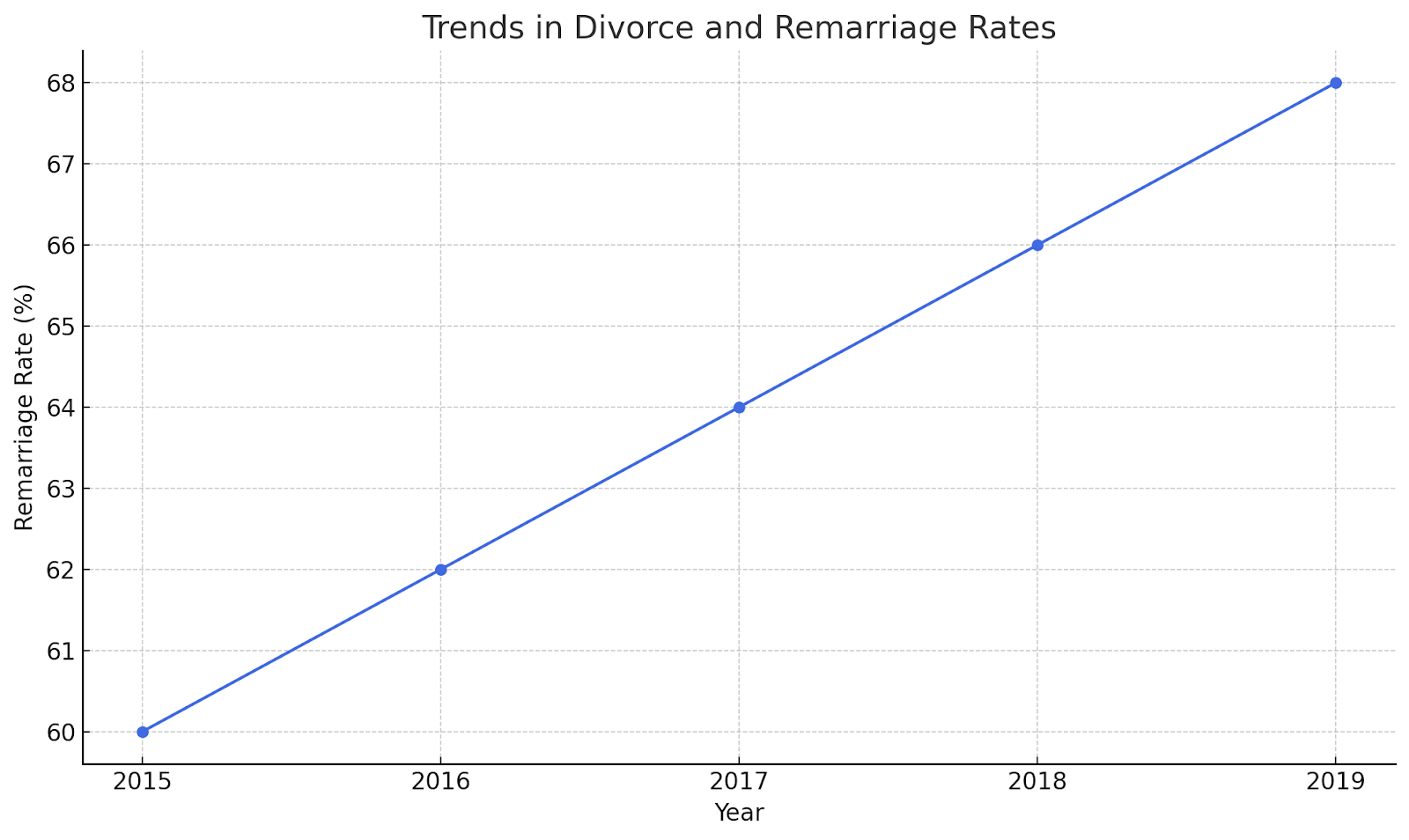
- Impact On Remarriage: 70-80% of people who divorce eventually remarry, with a significant number remarrying within 5 years of their divorce.
The following charts illustrate key trends:


Leawood Divorce Law FAQs
How long does it take to get a divorce in Leawood?
The timeline varies depending on whether the case is contested or uncontested. In Kansas, there’s a mandatory 60-day waiting period after filing. In Missouri, there is no minimum waiting period, but most cases take at least 30 days. Contested divorces involving disputes over custody, property, or support can take several months or longer in either state. Factors like court scheduling, case complexity, and cooperation between spouses can influence the overall duration. Delays often occur when one party is unresponsive or refuses to compromise on key issues.
Do I need to prove fault to file for divorce?
No. Both Kansas and Missouri are no-fault divorce states. You only need to state that the marriage is irretrievably broken or that there are irreconcilable differences. You don’t need to prove infidelity, abuse, or other misconduct to proceed. However, in limited cases, misconduct may still be considered when deciding issues like custody or division of assets. For example, a history of domestic abuse or financial mismanagement may impact how the court rules on parenting plans or spousal support.
What issues are resolved during a divorce?
Even if spouses agree on most terms, formalizing those agreements in a legally binding document is essential to avoid future legal challenges. A divorce proceeding generally includes:
- Division of marital assets and debts
- Child custody and visitation schedules
- Child support obligations
- Spousal support (alimony), if applicable
Each of these areas must be addressed either through agreement or court decision. Working with an attorney can help make sure your rights are protected during these negotiations or hearings.
How is property divided in a Leawood divorce?
In Kansas, the law follows equitable distribution, meaning assets are divided fairly but not always 50/50. Missouri also uses equitable distribution. Courts in both states look at each spouse’s financial situation, contributions to the marriage, and future needs when dividing property. Items acquired during the marriage are usually considered marital property, while gifts and inheritances may remain separate. Factors like earning potential, health, and who will have custody of children may influence how assets and debts are split.
Can we use the same attorney if we agree on everything?
No. Even in uncontested divorces, one attorney cannot legally represent both parties. One spouse can retain a lawyer to draft the necessary paperwork, but the other should have the opportunity to seek independent legal advice before signing any agreement. This helps avoid future disputes and confirms that both parties understand the terms of their divorce. It’s especially important to have individual representation when dividing assets, setting support terms, or developing parenting plans.
Do I have to go to court for a divorce?

Leawood Divorce Glossary
At the Law Office of Daniel E. Stuart, P.A., our Leawood divorce lawyer is committed to providing professional and experienced legal assistance to individuals facing divorce. Divorce involves numerous legal terms and processes that can be overwhelming, so we’ve outlined key terminology to help clarify the legal framework of family law in Missouri and Kansas.
Equitable Distribution
Equitable distribution refers to the method courts use to divide marital property during divorce. Unlike community property states, where assets are divided equally, equitable distribution focuses on what is fair, though not necessarily equal.
For example, one spouse might retain the family home while the other receives a greater share of retirement funds to balance the division. Missouri follows this principle, taking into account factors such as each spouse’s financial situation, contributions to the marriage, and the value of non-marital property.
When handling asset division, we collaborate with appraisers, financial specialists, and accountants to ensure every asset is properly identified and valued. This is especially critical for high-net-worth divorces or cases involving businesses, where missteps could lead to financial inequity.
Spousal Maintenance
Spousal maintenance, commonly known as alimony, involves financial payments made by one spouse to the other after divorce. Courts may order maintenance to provide financial support to a lower-earning spouse or one who has sacrificed career advancement for the marriage. For instance, a spouse who left the workforce to raise children might receive rehabilitative support while they pursue education or training to re-enter the job market.
Factors influencing spousal maintenance include the length of the marriage, each spouse’s earning capacity, and the standard of living during the marriage. Payments may be temporary, permanent, or rehabilitative, depending on the circumstances. We guide clients through this process, working to secure fair outcomes that reflect their long-term financial needs.
Parenting Plan
A parenting plan is a legal document outlining how divorced or separated parents will share responsibilities for their children. This plan includes custody arrangements, visitation schedules, decision-making authority, and how parents will resolve disputes. For example, a parenting plan may specify that the child spends alternating weekends with each parent and that both parents share legal custody, meaning they collaborate on major decisions like education and medical care.
In Missouri and Kansas, courts prioritize the child’s best interests when approving parenting plans. We help parents craft plans that are practical and enforceable, minimizing conflict while focusing on the well-being of the child.
Contested Divorce
A contested divorce occurs when spouses cannot agree on one or more key issues, such as asset division, spousal maintenance, child custody, or debt responsibility. These disagreements may require court intervention to reach a resolution. For example, if one spouse insists on keeping a jointly owned business while the other demands an equal split of its value, the court may need to decide how the asset is handled.
Contested divorces often involve multiple hearings and a more extended timeline, making experienced legal representation essential. We represent our clients with tenacity and dedication in court, ensuring that their interests are protected and their voice is heard.
Separate Property
Separate property refers to assets owned by one spouse before the marriage or acquired during the marriage through inheritance or gifts, provided they were not commingled with marital property. For example, if a spouse inherits a vacation home and keeps it solely in their name without using marital funds for upkeep, it may remain their separate property in a divorce.
However, disputes can arise when assets have been commingled, such as using marital funds to renovate the inherited home. We assist in identifying and protecting separate property to ensure it is not unfairly divided in the divorce process.
Law Office of Daniel E. Stuart, P.A., Leawood Divorce Lawyer
4707 College Blvd, Leawood, KS 66211
Schedule A Consultation Today
Divorce lawyers play a crucial role in navigating the complexities and emotional challenges of ending a marriage. With laws and requirements constantly evolving, having a knowledgeable and compassionate attorney by your side is invaluable. The Law Office of Daniel E. Stuart, P.A. stands out in this regard, offering personalized and dedicated legal representation that addresses the unique needs of each client.
Whether it’s handling asset division, spousal support, child custody, or the divorce process itself, our team is committed to providing the clarity, support, and advocacy needed to navigate these difficult waters.
Choosing the right divorce lawyer in Leawood, can significantly impact the outcome of your divorce proceedings. Our approach is not just about legal representation; it’s about offering a guiding hand through one of life’s most challenging transitions.
With a deep understanding of Missouri’s divorce laws and a compassionate approach to each case, we’re here to help you move forward with confidence and peace of mind. Reach out today to set up a consultation.